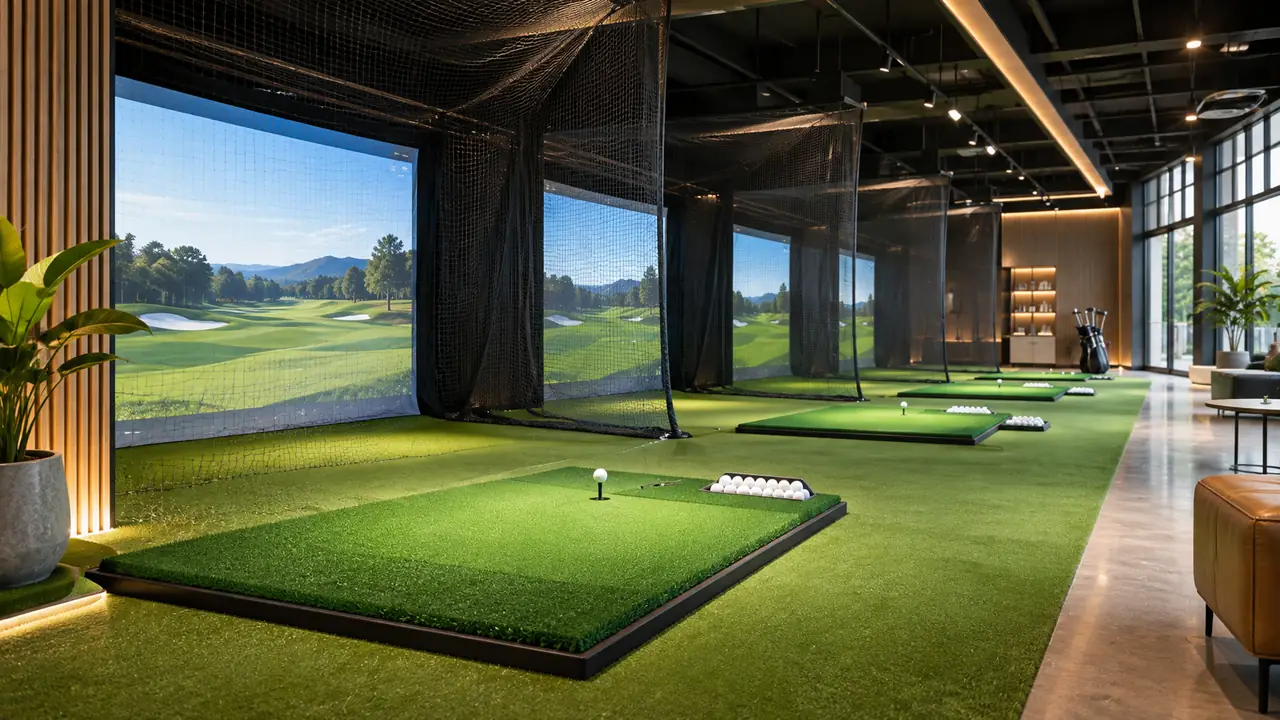
For commercial ranges choose dense nylon or 3D elastic-fibre turf on a thick shock-absorbing rubber or foam base, with tee-holding turf or rubber tee holes. Polypropylene turf on thinner foam is more economical for home use.
Turf fibres
- Nylon: resilient, springs back after impact, long life — best for ranges.
- Polypropylene: softer and cheaper, flattens faster — best for home mats.
- 3D / elastic textile fibre: lets the club brush through like fairway grass, giving more realistic feedback.
Base and shock absorption
A thick foam or rubber base protects players' wrists and elbows and stops the mat sliding. Commercial mats use heavier bases; portable mats use lighter foam that is easy to roll and carry.
Tee options
High-density tee-holding turf accepts real wooden and plastic tees. Rubber tee holes are more durable in high-traffic bays. Many ranges use replaceable hitting strips to extend mat life.
Common sizes
| Use | Typical size | Notes |
|---|---|---|
| Driving range bay | 1.5 × 1.5 m | Heavy base, stance area included |
| Simulator | 1.5 × 1.5 m or custom | Pairs with a stance turf |
| Home practice | Portable sizes | Lighter foam, foldable options |
Browse our golf training gear or ask for samples.
Frequently asked questions
How long does a commercial mat last?
It depends on traffic and turf type; dense nylon and replaceable strips last longest.
Can mats be logo-printed?
Yes, logos can be added to mats and bases for clubs and simulators.
Do you sell rangefinders?
Yes — USB rechargeable laser rangefinders with up to 600 m range.