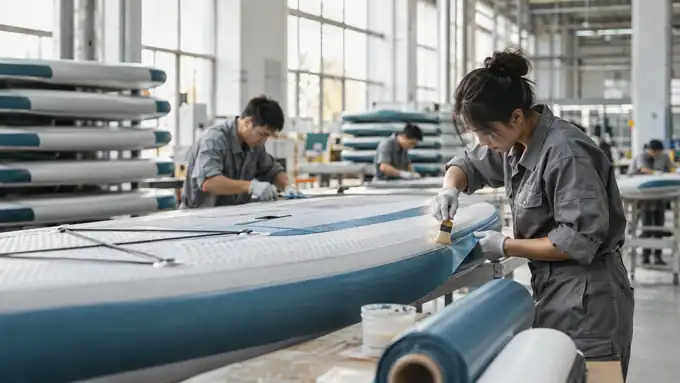
Lock the specification sheet, approve a pre-production sample, supply vector artwork with Pantone references, agree an inspection plan (including a 24-hour pressure test), confirm Incoterms and carton sizes, and collect compliance documents for your market before balance payment.
1. Write a complete specification
List dimensions, thickness, construction (single, fusion or double-layer), weight, maximum pressure, fin box, valve, D-rings, deck pad and every accessory in the kit. A precise spec sheet prevents most production surprises.
2. Approve a sample
Order a sample in the final materials and graphics. Test it on the water, check weight and stiffness, and sign off a "golden sample" that production must match.
3. Prepare artwork correctly
- Supply vector files (AI, EPS or PDF) with outlined fonts.
- Give Pantone references for every colour.
- Confirm logo positions on board, bag, paddle and packaging.
4. Agree the quality-control plan
A good pre-shipment inspection includes a 24-hour pressure-hold test, seam and valve checks, dimension and weight checks, accessory counts, carton markings and a drop test. Ask for photo and video reports before balance payment.
5. Plan logistics and Incoterms
Agree whether you buy FOB (you control the ocean freight) or CIF/DDP (supplier arranges more of the journey). Inflatable kits are compact — confirm carton dimensions and pieces per container early so you can calculate landed cost.
6. Collect compliance documents
Requirements differ by market. Ask which certificates are available for each model (for example CE documentation for the EU), and request test reports for any lithium-battery pumps (UN38.3 and MSDS).
7. Build a realistic timeline
Allow time for sampling, artwork approval, production, inspection and transit — and plan launches around your selling season, not the factory calendar.
Ready to start? Send your spec to our team via the inquiry form or browse inflatable SUP boards.
Frequently asked questions
What is a golden sample?
The approved sample that sets the standard for mass production. Inspectors compare production units against it.
FOB or DDP?
FOB gives you control and transparency over freight; DDP is simpler but usually costs more. Choose based on your logistics capability.
What should a QC report include?
Pressure-hold results, dimensions, weight, workmanship, accessory counts, carton markings and photos/videos.